


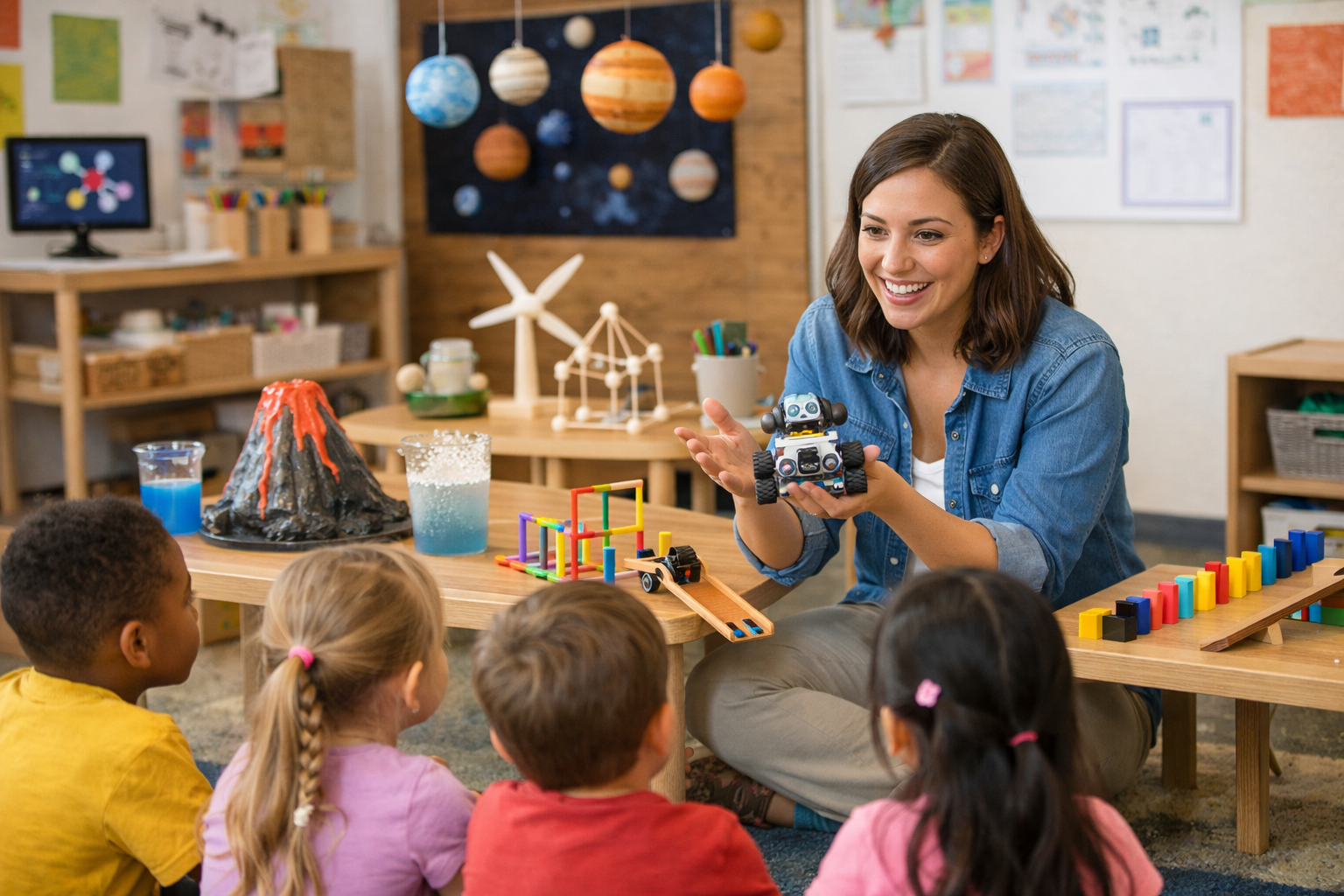
When people hear “AI in schools,” they often imagine robots replacing teachers or preschoolers glued to screens. That’s not only inaccurate, it misses the real potential of artificial intelligence in early education.
At the preschool level, AI isn’t here to teach shapes and colors or control the classroom. It’s here to support foundational thinking habits like pattern recognition and sequencing. These skills are the building blocks for STEAM learning and future problem-solving, and young children are naturally wired to develop them.
Most importantly, this isn't about putting screens in front of children. It's about giving teachers smarter tools to guide them.
Building thinking skills through everyday routines
Before a child can code, they need to recognize a pattern.
Before they can solve problems, they need to understand cause and effect.
Before they can build a robot, they need to know what a sequence is.
These are not lessons found in textbooks. They’re built through daily moments like lining up toys by color, following instructions for snack time, or retelling a story in the right order.
These moments may seem small, but they strengthen how children think. That’s the kind of learning AI can help support.
How AI works in preschools without screens
In early childhood, learning should stay hands-on. Children learn best by touching, moving, talking, and exploring. That’s why the best use of AI happens quietly in the background, helping teachers plan lessons, track progress, and respond to each child’s needs.
You don’t need an app for a child to practice thinking in steps. Tools like programmable robots, story cards, and pattern games already encourage sequencing and logic through play. What AI does is help teachers make the most of these tools.
For example, AI can:
- Suggest activities that match a child’s level
- Recommend different ways to teach a familiar idea
- Help spot learning gaps early, so teachers can step in quickly
This is about giving teachers more support, not more devices.
The teacher is still the heart of every classroom
No algorithm can replicate a teacher’s intuition. Technology can help with planning. It can even offer good suggestions. But it can’t replace a teacher’s instinct or care.
Children need warm, trusted adults to guide their learning. A teacher knows when to slow down, when to encourage, and when to step back. That kind of human insight is what makes the difference in every classroom.
This is why training matters just as much as the tools themselves.
How Little Lab helps teachers bring it all together
At Little Lab, we focus on making STEAM learning feel simple, practical, and joyful for teachers.
- The Teacher Training Academy (TTA) offers short, clear modules that help teachers understand how to bring logic, patterns, and sequences into the classroom through play. The content is hands-on, age-appropriate, and fits into real teaching schedules.
- The Teaching Toolbox (TTB) provides ready-to-use resources like storytelling cards, early coding games, and activity kits that introduce problem-solving in fun, developmentally friendly ways.
Together, they help educators create classrooms where young children build stronger thinking habits without losing the joy of learning.
One step at a time
AI will never replace a teacher. But it can help teachers raise the standard of learning, thinking, and exploring in the classroom.
Let’s stop imagining robots and start imagining confident, curious little thinkers, help building their future one pattern at a time.
When combined with strong training and practical tools, AI can help make everyday learning more thoughtful, more personalized, and more joyful. And it all starts with the basics.
A pattern. A sequence. A single curious question.
If you're ready to explore how Little Lab can bring this into your school, book a demo with us today and see how it works in your school.